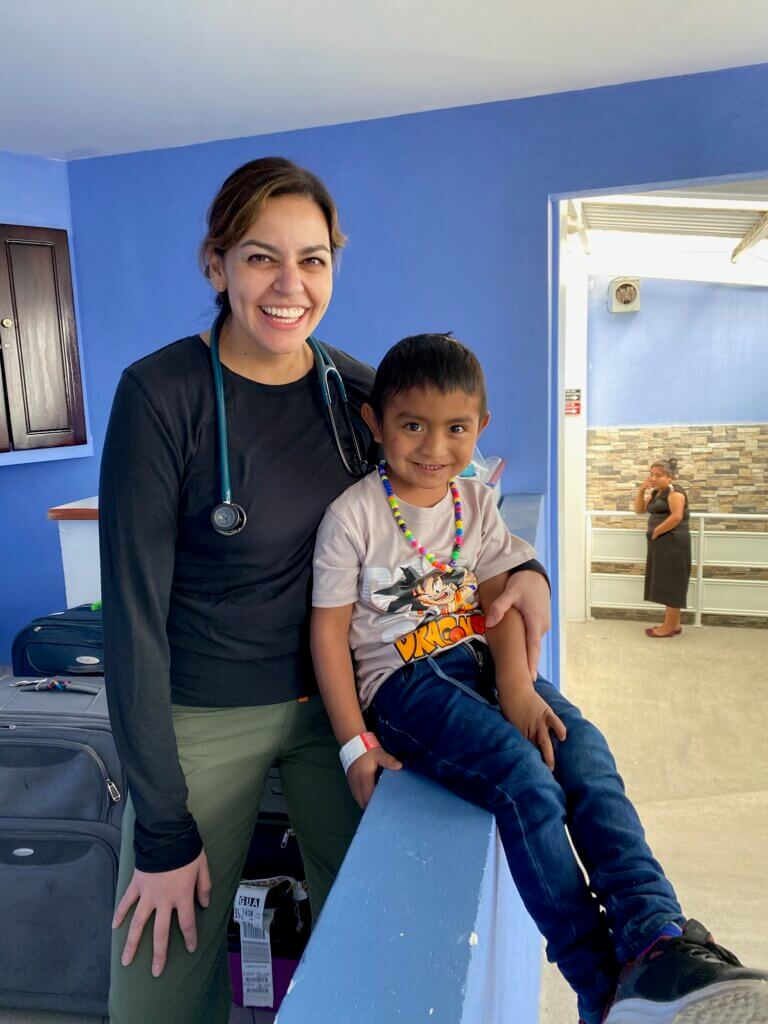
After the Iowa Miles of Smiles Team arrives in Huehuetenango, the group gathers for breakfast and — when possible — dinner each day. Every year before the first day of surgeries begins, Dr. John Canady always recounts the same story about an airline worker doing cleanup around an airplane readying for takeoff. The airline worker finds a bolt on the ground and having no idea whether it’s just junk or something important, the airline worker takes it to someone to ask. And I think you can guess that it did turn out to be so important that not letting someone know could have resulted in the airplane crashing and potentially losing lives. This story gets shared every year because it truly takes every single person on the team–medical and non-medical–working together to make sure that nothing gets lost in translation or overlooked during the mission. There are many critical safety components for a small medical mission like Iowa Miles of Smiles Team, and I talked with Anesthesiologist Dr. Martin Mueller, who has been on the Iowa Miles of Smiles Team more than 10 years, about the safety considerations related to pediatric anesthesia for the mission.
Dr. Mueller notes that the unthinkable—losing a child—is a real possibility that can happen very quickly. It is imperative for the team to to have sufficient preparation for adverse events, and patient screening has a critical impact on identifying potential issues before they have a chance to arise. Guatemalan families do not have access to primary care which means that health issues may not have been identified before they come to the Iowa MOST screening day to seek care.
There are three key challenges when it comes to safety as it relates to anesthesia: inadequate access to healthy nutrition so the kids we see tend to be slightly undernourished and small for their age; constant exposure to woodsmoke which makes the children’s airways hyper-reactive and therefore more prone to to adverse reactions to anesthesia (laryngeal spasm and bronchial spasm), and also chronically inflamed so it’s more difficult to supply oxygen; and third, the high elevation makes kids hypoglycemic due to the air pressure, which means they naturally have oxygen depletion which their physiology has adapted to but still presents a challenge to the anesthesia team since maintaining good oxygen supply is critical for preventing Irreparable damage to a child’s brain or losing a child if there is a crisis. If there is a crisis, losing a child can occur within 3 or 4 minutes and is ever-present on the minds of the anesthesia team.
The reality is that it is not uncommon for challenges to arise and so it’s essential to be prepared for problems, especially a major disaster—this preparedness is the foundation of safety for a mission like Iowa MOST and one that our team takes great pride in. The components of our team’s safety preparedness are the following:
1. Defibrillator training to the team in case it is needed during the mission—on arrival to the Hospital Especialdades, Dr. Mueller conducts the training to make sure everyone knows where each defibrillator is located, that each is charged and working, and everyone has a refresher on how to use it. A defibrillator is located in all critical locations in each O.R. as well as in the post-op recovery area.
2. As part of any anesthesia procedure, it is necessary to place a breathing tube for multiple reasons — to provide oxygen, to give anesthesia, and to prevent secretions from entering the lungs. The usual placement of the breathing tube is called direct laryngoscope, when the tube is placed behind the tongue and the tongue is pulled forward to create view of voice box so the doctor can see where to place the breathing tube into the trachea while the the patient is asleep. Perhaps it goes without saying, but there is a significant amount of training for anesthesiologist in order to acquire the skill and knowledge to do this. This method works for most patients but sometimes the patient has unfavorable anatomy that prevents direct laryngoscopes. For this mission, Dr. Mueller brought an instrument called a video laryngoscope—this was an incredible addition to the equipment available to Iowa MOST thanks to the University of Iowa’s Department of Anesthesia. Being prepared for this contingency means all the difference in our ability to safely deliver anesthesia and provide good medical care to these precious kids. Portable video laryngoscope are something most missions would not have access to so we feel fortunate to have built partnerships which have given us this opportunity. It proved itself on the very first day when one of the patients could not be intubated and so the video laryngoscope was essential to perform a safe intubation for the palate surgery.
3. Preparedness for an MH crisis (malignant hyperthermia) is another consideration for disaster preparedness. MH is a rare hereditary condition of a life-threatening crisis upon exposure to certain anesthesia agents. Although it’s a very rare condition, it is fatal if not treated. One of the specific medications necessary for treatment is called Dantroline, which is very expensive and would not be readily available in Huehuetenango. Dr. Mueller and Team Leader Deb Dunkhase applied for and were awarded a grant by the manufacturer which allowed them to have 3 vials on hand in the event we encountered me this very rare but fatal condition. Normally this would have cost $7500 and would be considered cost prohibitive for a mission like ours. The O.R. Team had a training session at the beginning of the mission to ensure every person knew the procedures and their specific role in the event of an MH crisis. This was an extra precaution that makes us feel even better about our safety measures for the kids.
4. The Iowa MOST mission is supported by the University of Iowa Department of Anesthesia for resident training. As part of this support, they provide a hand-held wireless ultrasound machine for the global mission trips including Iowa MOST. It’s very small— the size of a TV remote control—and incredibly effective for a wide variety of medical uses. It has two probes—one larger and one smaller, which allow evaluations of any part of the body. It can be used to place an i.v. into larger veins you couldn’t see with the naked eye. Having the technology is one thing but having the training to use it is even more important. Our anesthesia residents have special rotations which allows them the opportunity to practice using this technology. Dr. Mueller is also doing continuing medical educations related to what is called POCUS, or Point of Care Ultra-Sound. This is a structured approach to evaluate patients who have a deteriorating situation using ultra-sound. Quick and easy diagnostic method to be able to identify gross abnormalities. Residents receive this training throughout their residency and Dr. Mueller is currently completing his training in this area as part of his CME. One day the anesthesia team was called to pre/post because there was a child with a heart murmur. Sometimes a heart murmur can be indicative structural abnormalities of the heart. Normally, we would have had to send the child for additional screening with another hospital facility but based on Dr. Mueller’s coursework he was able to determine that it was safe to proceed with anesthesia.
The Iowa Miles of Smiles Team is dedicating to delivering top-notch medical care to the families we care for in Guatemala. Our biggest challenge for next year is to replace one of the two anesthesia machines we use at Hospital Especialdades so we can run two operating rooms simultaneously. We will continue to ensure that we have great equipment, great team members, and great training so we can continue to conduct this Rotary mission with the highest standards of safety. Here’s to the Iowa MOST mission in 2024 and beyond!